Description


A diary of my birding activity covering highlights and photos from my birding adventures. Mainly Norfolk (UK), occasionally beyond. I might mention the odd thing that isn't avian, but for moth and other insect news check out my mothing diary.

Showing posts with label Wigeon x Mallard. Show all posts

Monday, 16 January 2017

Happy New Year

New Year's Day was a washout so I waited to 2nd to start 2017's birding adventure.  Dave and I headed up to Titchwell where a Barn Owl showed on a post opposite the end of Choseley Road.  As we headed down the main path a Kingfisher flashed by and 15 Avocets were on the freshmarsh.  The sea was busy but with the wind a bit stronger than we would have liked it wasn't so easy to see and count the ducks - at least 20 Long-tailed Ducks and 6 Velvet Scoter was no doubt a small fraction of the birds out there.  Divers included one Great Northern Diver while one positive result of the wind was a pair of Great Skuas flying west.  I checked a small party of Brent Geese flying west along the surf and was pleased to see that one of the birds in the flock appeared to be a Black Brant.  Given the fly-by nature of the views it would be impossible to rule out a hybrid towards the Black Brant end of their range of variation but I should think it was most likely a pure bird.  As we headed back to the car a Water Pipit dropped in on Thornham Marsh where it was good to be able to compare it to a Scandinavian Rock Pipit.

A drive round looking for geese and things turned up a few including 4 White-fronted Geese on their own next to the road between Fring and Docking.  Between Ringstead and Choseley we stopped to look at a small flock of Pink-feet (and a larger flock of Brents) - among the Pinks were 14 White-fronted Geese.

Holkham Park produced Nuthatch calling but fewer woodland species than normal.  The lake held the magnificent returning Pochard x Ferruginous Duck hybrid along with at least 45 Pochard.

Pochard x Ferruginous Duck hybrid, Holkham Park, 2nd January


From just NW of the lake we looked across to Holkham Freshmarsh where I noticed the Great White Egret in the distance.  We enjoyed watching some Red Deer round here too, including a couple of stags butting heads, albeit in a pretty half-hearted fashion.


Red Deer, Holkham Park, 2nd January


Dave was keen to see the Wigeon x Mallard hybrid at Stiffkey, and quite rightly so.  We duly stopped and had a look - it was one of the closest birds to us.  Also a Chiffchaff here.


Wigeon x Mallard hybrid, Stiffkey, 2nd January


Finally we stopped off at a former Red Kite roost to see if there were any there.  There weren't, but a couple of miles away we stumbled across a couple.  We stopped suspecting a roost and eventually saw at least 11 Red Kites.

Red Kite, north Norfolk, 2nd January


Next day I popped up to Salthouse primarily to see Steve Williams who was a good mate at UEA back in the early 90s.  We used to go on many twitches and birding sessions together - I have fond memories of tearing up to Sheringham for an Alpine Swift in his 2CV, on two wheels round the corners with The La's "There she goes" blaring out of the speakers.  On another twitch we arrived too late in the afternoon to see a Desert Warbler at Flamborough Head so had to sleep in the 2CV and wait for morning.  With gaps round the windows you could put your fingers through it wasn't the best overnight accommodation in a howling gale on Flambourough Head, but we did see the bird in the morning.  Apart from seeing Steve for the first time in 23 years it as nice to have a look at the flock of 50 Snow Buntings feeding on the shingle ridge just east of Gramborough Hill.  Actually, checking photos there were 52 Snow Buntings.


52 Snow Buntings, Salthouse, 3rd January


As we walked back to the car the flock followed us with some birds going down on the puddles between the hill and the car park.

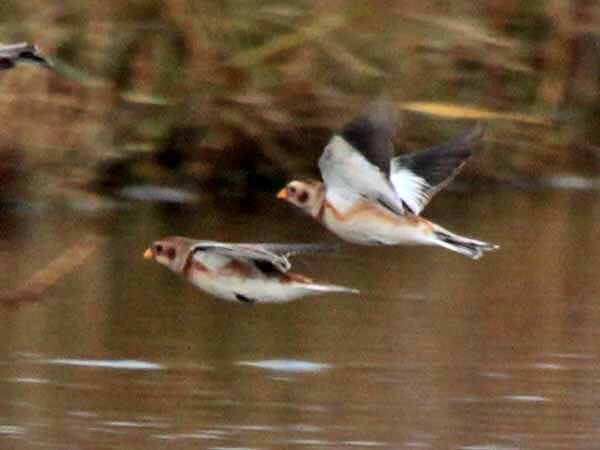
Snow Buntings, Salthouse, 3rd January


This Herring Gull gave the impression of being big and dark making me wonder if it might be argentatus.  Really not sure though - any ideas welcome.


Herring Gull, Salthouse, 3rd January


On the way home I stopped off at Bayfield Lake.  While I was there several skeins of Pink-footed Geese were flying over.  One group came down and circled the lake as if they were going to land, although they eventually carried on off, but these were no Pinks.  This party of 12 birds proved to be a mixture of Tundra Bean Geese (the majority, probably 9) and White-fronted Geese (at least 3).  On the deck among the feral Greylags was another party of 6 White-fronted Geese.

White-fronted Geese, Bayfield Lake, 3rd January


I also had a quick look at the local patch where the White-fronted Goose flock remained - I couldn't tell how many birds were here on this occasion as they were mostly keeping out of view in long grass behind Greylags.

Two days later I couldn't find the White-front flock at all, though they were seen later.  I counted 646 Greylag Geese while looking.  Nothing else on the patch better than Bullfinches and Marsh Tit, both of which are regularly encountered there at the moment.

On 6th I headed to my old patch of Swanton Morley for the first time in ages.  Saw a Little Owl on the edge of Swanton Morley village on the way.  As I walked round the fishing lakes a Redpoll flew over, but none were in the alders where they used to frequent.  A Peregrine flying over was good for the site, or at least it would have been a few years ago when I went there more often.  Little Egret, Bullfinch, Treecreeper and 10 Siskins were more typical records for the site.  A flock of 5 swans flew directly over my head and away to the north west.  I couldn't see their bills at all but I got the distinct impression that they were Whooper Swans, the immatures looking grey and the necks long.

I then drove through Bylaugh and Sparham Hole stopping at the corner to look at a small bunting flock.  As I stopped I picked up a distant flock of 5 swans flying north-west, the same direction as the previous flock of 5 suspected Whoopers.  Frustratingly they were too far off to see any detail of the bill pattern (except to eliminate Mute Swan which was already eliminated by the grey plunage tones of the immatures).  From the length of the neck I am pretty sure these were Whooper Swans too, but annoyingly I can't be positive about the ID of either flock.  Either Bewick's or Whooper would be good for the Wensum Valley.  As I received reports from other observers during the day it became clear that there was quite a passage of Whooper Swans around the county so I very much expect that that's what they were, but there were Bewick's reported on the move too so I still can't be 100% certain.

I only managed to get a good look at 4-5 birds from the bunting flock I stopped for (including Yellowhammers and Reed Buntings) - the others disappeared as I stopped, or maybe there weren't as many as I thought in the first place.  In the field were over 400 Linnets and some thrushes.

Mistle Thrushes, near Sparham, 6th January


Next day I was up at Titchwell with the usual group.  We headed to Patsy's Pool first where a first-winter drake Goldeneye was the highlight.  This Robin was very tame...

Robin, Titchwell, 7th January


As we headed back a female Bullfinch provided brief views for the group.  We headed to the beach next fearing that the mist would close in preventing views later on.  On the way out there were 2 Spotted Redshanks and a Water Rail swimming towards us.


Water Rail, Titchwell, 7th January

 
On the sea the birds weren't as close in as they sometimes are and with the mist and breeze it wasn't ideal conditions for getting the group on to Long-tailed Ducks and Velvet Scoters.  At least 15 Goldeneyes. 8 Red-breasted Mergansers and 3 Eiders too, but no sign of any of the Glaucous Gulls that had been there the day before.

We retreated to the relative warmth of the central hides where 16 Avocets were counted.  Most of the group then returned to the cafe while two of us headed back to the beach where the ducks were showing slightly better now, including at least 25 Long-tailed Ducks and 15 Velvet Scoters.  A brute of a juvenile Glaucous Gull was picked up washing itself in the sea just offshore towards Brancaster.  As we headed back to join the others in the cafe I looked for Water Rails in the ditches as I always do, saying to Jos, "I haven't seen a Water Rail here for a while."  Someone coming the other direction overheard me and said, "There's one down there."  Sure enough there was a Water Rail right under my nose.

Exciting news emerged from Newmarket on the evening of 8th January.  Someone had photographed a warbler coming down to drink from a puddle in a car park and asked for ID.  The photos were quite good and appeared to show an Orphean Warbler.  There was much discussion about the identity on social media, but all I saw was focused on whether it was a Western Orphean Warbler or an Eastern Orphean Warbler.  Any Orphean Warbler is ultra-rare in the UK and it has long been one of my most sought-after birds.  I've always loved Sylvia warblers, even the common ones.  The scarce Barred Warbler was one of my earliest self-found birds of that calibre and in the early 90s I connected with Britain's first Spectacled and second Marmora's Warblers, Norfolk's first Rüppell's and Desert Warblers, and Sardinian and Subalpine Warblers.  In these pre-split days when there was only one species of Orphean Warbler, one Subalpine Warbler and one Lesser Whitethroat that left just Orphean Warbler to complete an impressive list of birds in my favourite genus.  With the various recent splits there are now new gaps to fill but Orphean has remained very high on my most-wanted list.  And now there was one overwintering in a car park in Newmarket!

I arrived before dawn and quickly located the car park and even the puddle it was photographed drinking from.  Thick vegetation behind it might be where it was lurking, but there was plenty of equally good habitat around.  An apple tree nearby was worth keeping an eye on - the Pembrokeshire Orphean a few years ago liked apples.  A crowd stayed looking in the car park while others of us spread out wandering around the estate peering in gardens and scouring shrubbery.  Hours later the Orphean Warbler had failed to show and it was starting to look like we would dip.  A Grey Wagtail and a Bullfinch were the best birds I'd seen!

After one more circuit of the estate I walked back towards the car park and looked up at the apple tree.  Out of the corner of my eye I noticed Mick Saunt walking away from the apple tree but stop in his tracks before looking back at it, and at this point I locked on to a Sylvia warbler, a Lesser Whitethroat-like bird, feeding in the tree.  Surely this was it...  Being cautious I shouted, "Sylvia warbler" but surely this was going to be the Orphean - the odds of a Lesser Whitethroat being here in January as well were very remote.  I got my scope on it excitedly and was elated to see it had a pale eye (Lesser Whitethroats have dark eyes and Orphean Warblers have pale eyes) and a big-looking bill (another feature of Orphean).  It was the Orphean Warbler!  I was so happy I punched the air - a bird I'd wanted to see for so long had just appeared in front of me.  It soon moved back to the cover that it turned out Mick had seen it fly to the tree from and I joined the crowd.  The bird hadn't seemed as big as I had expected - Orphean Warblers are big for Sylvia warblers - this one looked really quite a lot like a Lesser Whitethroat.

I remarked to someone how easy it would be to overlook one as a Lesser Whitethroat as it appeared again in ivy before returning to the apple tree again.  By now it was raining but I checked the undertail to look for clues as to which form of Orphean it was.  There is some variation but I think Western tends to have a creamy coloured vent whereas Eastern tends to be whiter with dark markings.  It looked white, but clean.  Another look at the face confirmed the eye colour and the bill.  Actually the feathering round the bill was worn making the bill look longer than it really was - taking that into account it wasn't all that obviosuly bigger than a Lesser Whitethroat's bill, though at this point I did think it was a bit stouter too.

The bird we were looking at was quite obviously the same bird we had seen in the photos last night, and last night there was no question about the bird's identity as an Orphean Warbler.  It was an Orphean Warbler last night, and this was the same bird.  I think if there had been no photos last night, but just a claim of an Orphean Warbler, my process of being critical about the identification would have been different, more suspicious, more cautious.  I guess that's why it took a little longer for me for the penny to drop that this Lesser Whitethroat-like Orphean Warbler might not actually be an Orphean Warbler.  Perhaps the penny would have dropped quicker if I'd seen more Orphean Warblers abroad too.  But as it was it took other experienced observers on site to say they thought it was just a Lesser Whitethroat.  Slowly I started to realise that yes, that would explain why it looked so much like a Lesser Whitethroat.  But the pale eye - one or two people were questioning whether it really had a pale eye - well yes, it definitely did!  But apparently Lesser Whitethroats sometimes do have pale eyes, especially eastern ones I subsequently learned.  I probably should have known that already but somehow that piece of knowledge had bypassed me up to now.  Some of the photos still looked like they showed a big bill, not just long, although admittedly it didn't look so good in other photos.  I wasn't completely convinced, but as the rain hardened I retreated to my car and checked Twitter where one of the photographers present had already posted some pics of the bird.  They showed a bill that was clearly too fine for any Orphean Warbler - long due to the tatty feathers at the base of the bill, but fine.  The nail was in the coffin now - there was no way of avoiding the crushingly disappointing conclusion that this bird was indeed a Lesser Whitethroat and not an Orphean Warbler.

Lesser Whitethroat, Newmarket, 9th January

Saturday, 24 December 2016

Goosing about and a Dusky Thrush

What seems to be one of the best winters ever for goose-watchers in Norfolk largely passed me by until the second half of December.  My last few weeks of work proved busy and left me with little time to bird and more working from home meant less opportunity to pop out to see the local flocks during my lunch breaks.  I did manage a Barnacle Goose near Bircham on 5th December but  little more until after I finished work on 16th.

There have been several reports of Rough-legged Buzzard in the Choseley area this winter but at least some, and possibly all, have related to one or two pale Buzzards that are residing in the area.  Here's one of them.

Buzzard, Choseley, 9th December


Tree Sparrows bred at work this year, though I never saw any sign of them myself.  Shortly before I finished, my team moved to the building where Paul and Rachel Eele had seen them in the summer.  Rachel (who works with me) saw what she thought were Tree Sparrows from our office soon after we moved in but I was in a meeting at the time.  A few days later on 12th December I heard some Tree Sparrow calls and looked out of the window.  I could see 4-5 birds in the top of a nearby tree that looked like they might have been sparrows but there was a bird chirping much closer.  It took a while to see it but eventually I found it sitting on the drainpipe very close, followed by two more a bit further round.

I finished work on Friday 16th December (hooray!) having worked there nearly 15 years and don't plan to race back to employment.  On Sunday I headed up to Titchwell where there have been large numbers of sea duck close inshore recently.  A Chiffchaff was feeding beside the path between the car park and the visitor centre - nice to see at this time of year.

At the sea an RNLI dingy had just been through pushing the birds further out.  2 Great Northern Divers were pointed out upon my arrival (and later we counted 3).  The dingy came back past along the shore causing lots of duck to fly around - I counted 15 Velvet Scoters and 31 Long-tailed Ducks in a single scan though I'm sure the true number present was much higher than this.  I didn't count the commoner species very carefully so 8 Goldeneye, 10 Red-breasted Mergansers was probably way under too.  I picked up a pair of Scaup after a while and then Eddie picked up a Black-throated Diver flying west.  I think it was Ben who called a Kittiwake, and single Fulmar and Gannet were also seen in the distance.  Many hundreds of Common Scoter and a few Eider among them too - the sea was a real spectacle with birds everywhere.  Fantastic, and such a welcome change after the last winter or two when the sea here seemed weirdly quiet.


Black-throated Diver (and Long-tailed Duks), Titchwell, 18th December


I stopped at Choseley to look at the geese, but there weren't all that many birds in the flock here - clearly a lot were elsewhere.  Indeed the only interesting birds I could find among them were variants of Pink-footed Goose, with no other species at all.  One bird was a pink-billed, white-faced, white-spectacled bird that Mark G had emailed me about earlier in the week.  Apart from it's unusual pigmentation (or lack of) around its head and bill it was in every other respect a normal Pink-footed Goose, so I presume the explanation for its unusuall appearance is leucism or some other pigment-deficiency condition, rather than hybridisation (despite it recalling Lesser White-fronted Goose to some observers).  I've seen one or two Pink-feet with white spectacles before, lots with white round the bill and a few with almost entirely pink bills.  I don't recall seeing one with a pale nail before though.

Pink-footed Goose, Choseley, 18th December


Also in the flock were two birds with bright orange legs, but these were no Bean Geese (although were probably identified as such by at least one birder who thought there were Bean Geese in the flock - or maybe I just missed the real ones).  They failed to show any other feature of Bean Goose and Pink-footed Geese with orange legs are not all that unusual.

Pink-footed Goose, Choseley, 18th December


The pale Buzzard was in the area again too - not fooling anyone today though (at least not while I was there).

From the road between Docking and Brancaster Staithe a large flock of geese were feeding.  They were keeping back though - I suspected another birder had flushed them earlier.  It was hard to see a lot of the birds - a flock of at least 6 Barnacle Geese were right at the back but completely disappeared after I first saw them.  A Tundra Bean Goose was slightly easier to see but then another birder arrived and flushed the entire flock.  After that it was hard to see them without flushing them, and with other birders in the area I knew they'd all be flushed again soon.  Weekends are not the best time to look for geese when there are others looking - too many people without any field craft  getting out of their cars, slamming doors, walking up to the flocks, etc.  I decided to come back during the week, now that I can.

I was keen to see the Tree Sparrow x House Sparrow hybrid that's been at Cley recently so decided to head over there.  I made the mistake of stopping off on my way to have another look at the Wigeon x Mallard hybrid at Stiffkey.


Wigeon x Mallard hybrid, Stiffkey, 18th December


Lovely to see this again, but it cost me the sparrow.  I arrived at Cley and was immediately informed that the hybrid sparrow was showing on the feeders outside Cley Spy.  I headed straight there but the bird had disappeared and didn't reappear before the sun started to go down.  A single Tree Sparrow was there, but that wasn't the one I wanted!

Tree Sparrow, Cley, 18th December


Monday 19th December was the first "working day" of my non-working life, and I decided to celebrate it with a Dusky Thrush.  I picked up Dave at 4.30 am and headed to Beeley in Derbyshire arriving at dawn.  We had a look in the orchard for a while, that being one of its favoured locations, but it soon became clear that having everyone looking in one place wasn't a great tactic.  I exchanged phone numbers with someone there just in case it returned while we were looking elsewhere and headed down to the playing field.  No sign there, so we checked the churchyard.  Nothing, so up Pig Lane.  Dave pointed out a couple of Redwings in a hedgerow in fields some way off up the hill.  I scoped these for a while - eventually it became clear that there were a few birds, but no sign of the Dusky Thrush.  I kept looking, and then from behind a hedge out popped the Dusky Thrush!  It soon disappeared again but fortuately for Dave it quickly reappeared.  Not for long though as it took flight with a group of about 8 Redwings.

Earlier we'd passed the end of a footpath that headed up towards the flock which looked like it had gone back down in the same area.  We notified the crowd at the orchard and headed to the footpath arriving just slightly ahead of them.  A few Redwings were visible in the top of an oak tree but we couldn't see the Dusky Thrush.  I noticed there was a single bird in the nearer tree, largely obscured.  I could just make out a long flared supercilum and a solid dark block at the rear of the ear-coverts.  I'd seen photos of the Dusky Thrush and noticed it had a similar pattern, but could Redwing show that too?  The rest of the crowd hadn't seen it yet so I was a bit cautious calling it at this point, but as more of us looked we became increasingly convinced it was the bird.  Eventually it moved enough for us to be sure, and then dropped down to feed in the field in the open.  It moved around a few times before flying off, on its own this time, towards the main road.

Dusky Thrush, Beeley, 19th December


Dave and I headed over the road to the park where it had gone towards and found a large flock of Redwings, but we couldn't locate the Dusky Thrush among them, and we called it a day and headed home.

Next day I was planning to spend looking for geese, and that plan got stronger after a Red-breasted Goose was found in the flock the day before.  I arrived at the flock between Docking and Brancaster fairly early and joined Andy Stoddart and Peter Doulton for what I think we all agreed proved to be a really exceptional goose-watching experience.  They'd already seen the Todd's and fairly quickly got on to the Red-breasted Goose.  A lovely bird indeed, and an interesting one too as ageing it proved less than straightforward.  Normally 2 bold wing bars on the greater and median coverts with no obvious barring on the lesser coverts makes it an adult, whereas first-winters have 4-5 rows of barring on the wing-coverts, with the greater and median covert bars being less distinct than in adults.  This bird showed a narrow third wing bar on the upper lesser coverts and although they were hard to see in the field, photos (Marcus's) prove it had a fourth and fifth wing bar on the smaller lesser coverts too.  The flanks were boldly marked and there was no obvious white on the tail tip, but although some people are calling it an adult I'm yet to be convinced.  Frankly I don't have enough experience to resolve this one, but I wonder if it can't be a more advanced first-winter bird?


Red-breasted Goose, between Docking and Brancaster, 20th December


In the end I think we must have notched up at least 19 Tundra Bean Geese.  There was a flock of 6 and at least one of 2.  A party of 7 birds appeared later on (the 6 were still on show) and a little later Andy saw a group of 4 fly in.  Making sense of all the Eurasian White-fronted Goose sightings was equally tricky but there must have been 8-10 birds involved.  One pair of adult White-fronts was very interesting - one bird was a typical Eurasian but the other was much larger, bigger headed, bigger billed and less delicate looking.  The Eurasian had a weak flank stripe but the larger bird was much stronger (and had much more dark on the belly).  It was tricky determining the bill colour but the big bird seemed to be a bit orangey, if not orange.  Surely it had to be a Greenland White-fronted Goose, although I would have liked to have determined the bill colour more clearly.  The other thing that bothered me slightly about it was my view of the tail - it wasn't a clear view so I may have been mistaken, but it seemed to have a little more white on it than I would have liked.  All in all we ended up concluding it had to be Greenland, my only reservation being whether the rather unlikely possibility of it being a Greenland x Eurasian hybrid (which so far as I know has never been recorded) had been fully ruled out.  Sadly both birds flew off at an angle that prevented a clear view of the tail.

The Todd's Canada Goose took a long time to show itself to me but did eventually do so.  Other Branta were represented by at least 9 Barnacle Geese (8 seen together in flight while one was still in the field).  Also 2 Greylag Geese in the flock - my impression was that these weren't as small as some of the wild Icelandic birds can be, so perhaps feral in this instance?


Todd's Canada Goose, between Docking and Brancaster, 20th December


As more birders started to turn up and flush the flock we headed up to Titchwell to look at the putative Ferruginous Duck.  This was showing very nicely on Patsy's Pool but whether or not it was a pure Ferruginous Duck is not easy to answer.  It was a male, a brightly-coloured bird with a bright eye so tempting to think an adult male.  If so there was a lot iffy about it.  The head shape was too rounded, the bill had extensive black around the nail divided by a pale subterminal band that looked quite conspicuous at times (especially head on), the belly patch wasn't as clean and clear-cut as we would have liked and the rear flanks lacked much of a dark bar dividing them from the white vent.  Not a first-generation hybrid, but if it was an adult bird then I think that's quite a lot of imperfection to assume it is 100% Ferruginous.  However, I noticed a few scattered darker brown feathers in the breast, which I don't recall seeing on adults before - could these have been retained juvenile feathers?  And aren't those tail feathers quite spiky?  Doesn't that make it a bird of the year?  Seemingly very advanced if so, but I'm leaning towards that being its likely age - and if I'm right then that makes the head shape acceptable and the indistinctness of the belly too.  I get the impression (and this isn't supported by a lot of data) that pale subterminal bill bands are more typical in younger birds too, so I'm not entirely convinced it isn't pure if it's a first-year bird.  At the very least, captive birds that are labelled as Ferruginous Ducks can look like the Titchwell bird... but of course who knows what those captive birds really are!?  I would be very interested to hear from anyone who can provide evidence that eastern European Ferruginous Ducks look like this...


Ferruginous Duck or backcrossed hybrid, Titchwell, 20th December