We often go to Cornwall in the autumn, staying in the far south west, but for a change we decided to head down in early spring this year, staying on the Lizard peninsula. There are a few regular early spring migrants that frequently turn up down there that I fancied finding, like Hoopoe, Woodchat Shrike, Night Heron, Black-winged Stilt, etc. but of course it all depended on the weather. We stayed at Cury which worked out ok as a base, arriving late on Saturday 1st April. The M4 was closed so the journey down took us along the A303 where my first singing
Blackcap of the year was heard next to a traffic jam at Amesbury (where one of
3 Red Kites was seen). Despite passing Stonehenge slowly the places we were actually stopped had poor views so there was little opportunity to scan for the tame Great Bustard.
I spent mornings at Lizard Point, seawatching for a bit and birding the area for a bit, or more. I met some local birders here including Ilya who I'd met years ago when he lived in Norfolk. He kindly showed me round and introduced me to a few spots in the immediate area, including some tips as to where things like Hoopoe and Subalpine Warblers tended to turn up.
Seawatching from the point produced similar birds most days, regardless of wind direction and strength. Always lots of larger auks flying west (
Razorbills more numerous than
Guillemots it seemed) and usually the odd Puffin among them (or alone, often further out). The most I saw was
5 Puffins on Friday but I'm sure I'd have seen a good few more than that if I'd spent longer looking most days. There were always shearwaters moving west too - typically over 50 but over
500 Manx Shearwaters on Wednesday and 300 Friday. Over the week I saw at least
14 Great Northern Divers here, mostly moving east, but quite a few large diver sp. were probably this species. There was only 1
Black-throated Diver that I was totally happy with, although I was pretty sure 2-3 others were this species. A total of
9 Red-throated Divers, including 5 on Friday, were all moving west in contrast to the majority of the larger divers. Other seabirds included numerous
Gannets and a few
Fulmars and
Kittiwakes. Plenty of
Shags around too.
There were
2 Sandwich Terns on Wednesday and 1 on Friday,
4 Curlews past on Saturday but vis mig of anything but seabirds was thin on the ground. Some of the Swallows were probably moving and possibly some of the Goldfinches and Pied Wagtails (but hard to tell as local birds were also knocking around). There were
16 Carrion Crows in off on Friday and smaller numbers on other days too. A
Merlin flew in off the sea on Wednesday.
Resident local birds seen in the area included a pair of
Choughs which were seen near Caerthillian on Monday and Tuesday (one of them seen just east of the lighthouse on Friday and Saturday - perhaps the female was sitting by then?). Pairs of
Ravens were seen at Kynance and just east of the lighthouse.
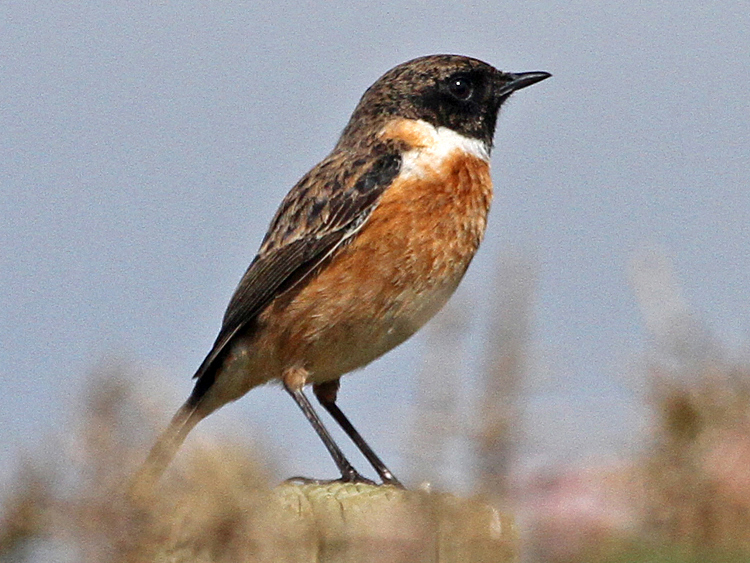
Stonechats were, of course, very numerous.
Stonechat, near Lizard Point, 4th April
Raven, Lizard Point, 8th April
Carrion Crow, Lizard Point, 6th April
Wren, Lizard Point, 8th April
Migrants were disappointing. There were south-easterly winds on Sunday but with clear skies they didn't seem to bring anything new in. Next day the wind turned to the north where it remained until the final Saturday. Most nights were clear and most days I didn't find a single new passerine migrant.
The forecast for Thursday was identical to that of the day before - clear skies and light northerly wind, so with nothing new in on Wednesday I didn't think Thursday would be any different and opted to go and look for the Hudsonian Whimbrel instead of birding the Point. I did have a look round in the evening but it was nearly dark by then. Needless to say I discovered the next morning that there had been far more birds around that day so I'd evidently missed the best day of the week. No idea why that day was so good but typical that I missed it. Mind you, it wasn't exactly heaving - sounded like a handful of Willow Warblers, the odd Wheatear and one or two other common migrants. With the possible exception of some of the
Chiffchaffs, the only new passerine migrants I saw most of the week were a handful of
Swallows and the odd
Sand Martin. Oh, and
2 White Wagtails on Friday. Also another
Merlin on Friday. One old migrant was nice though - I saw the
Woodchat Shrike that had been found at Kynance before I arrived every time my walk took me that far up - Monday, Tuesday and Friday (and on Thursday evening when I drove in that end).
Woodchat Shrike, Kynance, 6th April
Things finally improved on Saturday when the winds turned east/south-east, but with continued clear skies it wasn't exactly a big fall. There were
2-3 Wheatears around the point and at least one
Willow Warbler in, but this being our last day I had to be back at the cottage to pack the car up and leave so didn't have time to have a proper look round the whole area. I left thinking it would have been the ideal day to find a Hoopoe, had I had more time, and sure enough as I was driving home I got a message to say one had been seen flying in off the sea.
Wheatear, Lizard Point, 8th April
I managed to bird a few other sites while we were down there. On Sunday we walked from Church Cove to Porthleven and back, though from a birding perspective this didn't produce anything better than a Raven.
Raven, near Porthleven, 2nd April
Stonechat, Church Cove to Porthleven, 2nd April
I couldn't locate the public footpath marked on the map round Ruan Pool but eventually managed to find a path running along the north side to the hide overlooking the pool. It was hard-going - wet, muddy and a bit of a scramble, which I didn't enjoy much, and it wasn't worth it. I eventually discovered that access is easiest via Windmill Farm - a site I finally checked after leaving the cottage and before driving home on the last Saturday. I didn't have time to explore it properly but wished I had done so earlier in the week. I saw a pair of
Ravens and there were lots of
Willow Warblers in song.
I had a look round Goonhilly Downs a couple of times which produced another pair of
Ravens,
Bullfinches and lots of
Willow Warblers. Also a
Wheatear on Thursday. The pool and plantation at Croft Pascoe held more
Willow Warblers (these were also numerous around Ruan Pool and Windmill Farm) but I failed to find any rare herons or waterbirds on the pool - or at nearby Brays Cot. I attempted to view the pool at Hayle Kimbro but couldn't find a way to view it properly without wellies (and didn't bother going back to get them). I saw a
Marsh Harrier in the area which I understand had been around for a while.
On Monday we also had a look around the Helford area but apart from
Nuthatch and a singing
Blackcap I didn't find much.
On Tuesday I visited Hayle where Ryan's Field held
Spoonbill and
Greenshank.
Spoonbill, Hayle, 4th April
The main estuary (viewed from the causeway) held another
Spoonbill and the
Iceland Gull (which both remained asleep for the entirety of my time there) but I couldn't find the Ring-billed Gull.
Iceland Gull, Hayle, 4th April
St Gothian Sands was heaving with
Sand Martins.
Linnet, St Gothian Sands, 4th April
Rock Pipit, St Gothian Sands, 4th April
Sand Martin, St Gothian Sands, 4th April
On Wednesday we went to the Lost Gardens of Heligan where there were plenty of
Nuthatches calling as usual and a singing
Blackcap. It was heaving with people so I was surprised that the very beautiful Dodman Point, just down the road from here, was very quiet - just the odd clifftop walker. One such walker was quicker than I was to recognise a calling
Peregrine, and sharper than me too as he picked it up on the cliffs below before I did.
Dunnock, Dodman Point, 5th April
Chaffinch, Dodman Point, 5th April
I checked the reedbeds at Church Cove (Gunwalloe) and Poldu Cove (just down the road from where we were staying) a couple of times but struggled to find anything at all at either location. Apparently they can be good, but I didn't see any evidence of it.
On Thursday morning, as mentioned above, I went to Perranuthnoe to see the Hudsonian Whimbrel. This bird arrived in Scilly in October 2015 while I was staying in Cornwall and moved to Cornwall shortly after I'd left to come back home. It's a taxon I've never seen in the UK (though I saw quite a few in California in 2005) so I was keen to see it. Some authorities treat it as a separate species from our Whimbrel while other consider it to be merely a subspecies. I arrived a little later than planned to see 3 Curlew and a Whimbrel flying off to the east disappearing over the hills. The sun was directly behind them so they were completely silhouetted and I couldn't tell whether the Whimbrel was the bird I was after or not, but I figured it would be just my luck if it was - and not being aware if any normal Whimbrels were present or not it seemed quite likely. I wandered west to Boat Cove anyway, more in hope than expectation, pausing to look at a
Great Northern Diver on the sea. There were no Whimbrel (or Curlew) on the beach, at least so far as I could see. The scenery was nice though!
As I returned I continued checking and found a Curlew. Was this there before - in which case what else did I miss? Or had it flown in since I walked past - in which case had the Hudsonian Whimbrel flown in too? I couldn't see anything else and started to carry on - but was promptly interrupted by a Whimbrel calling. There was another bird down there, and eventually I located it. Clearly a Whimbrel but this bird was cold grey-brown lacking any warm buffy or cinnamon tones - not what I expected on a Hudsonian Whimbrel. The head pattern wasn't especially striking - no more so than on any other Whimbrel and the throat wasn't contrastingly pale. It was looking like this was just a
Whimbrel, and not the Hudsonian Whimbrel. Or was I just unaware of the extent of variation in Hudsonian Whimbrel - maybe some birds are subtler than I thought? I needed to see it fly!
Whimbrel (with Curlew in top photo), Perrantuthnoe, 6th April
By the time it did fly I was already convinced that this was not the boy I was after and sure enough eventually it flew off revealing a white rump extending up the back and distinctly ordinary underwings.
Whimbrel, Perrantuthnoe, 6th April
I kept looking, and as I did I heard another Whimbrel. I hadn't seen it arrive so can only assume it was down there all the time - birds among the rocks could be really hard to find! But when I did find this one it was standing on an isolated rock in the water, clear as day, so maybe it had just flown in after all? Anyway, this bird looked MUCH more interesting - surely this was the one. The head pattern was much more striking, it had a clean white throat and the body and wings were a warmer buffier brown compared to the Whimbrel.
Hudsonian Whimbrel, Perrantuthnoe, 6th April
As it preened I was pretty sure I could see its dark rump...
Hudsonian Whimbrel, Perrantuthnoe, 6th April
Eventually it flew a short distance and I was able to secure the ID beyond doubt - it was indeed the
Hudsonian Whimbrel.
Hudsonian Whimbrel, Perrantuthnoe, 6th April
I hadn't managed to get very good photos of it in flight so wanted to see it fly again, but it stubbornly refused to do so and even came quite close to the path where dogwalkers were passing without flushing.
Hudsonian Whimbrel, Perrantuthnoe, 6th April
The drive home on Saturday 8th was uneventful - just one
Red Kite near Maidenhead.