
A drive round looking for geese and things turned up a few including 4 White-fronted Geese on their own next to the road between Fring and Docking. Between Ringstead and Choseley we stopped to look at a small flock of Pink-feet (and a larger flock of Brents) - among the Pinks were 14 White-fronted Geese.
Holkham Park produced Nuthatch calling but fewer woodland species than normal. The lake held the magnificent returning Pochard x Ferruginous Duck hybrid along with at least 45 Pochard.

Pochard x Ferruginous Duck hybrid, Holkham Park, 2nd January
From just NW of the lake we looked across to Holkham Freshmarsh where I noticed the Great White Egret in the distance. We enjoyed watching some Red Deer round here too, including a couple of stags butting heads, albeit in a pretty half-hearted fashion.


Red Deer, Holkham Park, 2nd January
Dave was keen to see the Wigeon x Mallard hybrid at Stiffkey, and quite rightly so. We duly stopped and had a look - it was one of the closest birds to us. Also a Chiffchaff here.


Wigeon x Mallard hybrid, Stiffkey, 2nd January
Finally we stopped off at a former Red Kite roost to see if there were any there. There weren't, but a couple of miles away we stumbled across a couple. We stopped suspecting a roost and eventually saw at least 11 Red Kites.

Red Kite, north Norfolk, 2nd January
Next day I popped up to Salthouse primarily to see Steve Williams who was a good mate at UEA back in the early 90s. We used to go on many twitches and birding sessions together - I have fond memories of tearing up to Sheringham for an Alpine Swift in his 2CV, on two wheels round the corners with The La's "There she goes" blaring out of the speakers. On another twitch we arrived too late in the afternoon to see a Desert Warbler at Flamborough Head so had to sleep in the 2CV and wait for morning. With gaps round the windows you could put your fingers through it wasn't the best overnight accommodation in a howling gale on Flambourough Head, but we did see the bird in the morning. Apart from seeing Steve for the first time in 23 years it as nice to have a look at the flock of 50 Snow Buntings feeding on the shingle ridge just east of Gramborough Hill. Actually, checking photos there were 52 Snow Buntings.


52 Snow Buntings, Salthouse, 3rd January
As we walked back to the car the flock followed us with some birds going down on the puddles between the hill and the car park.

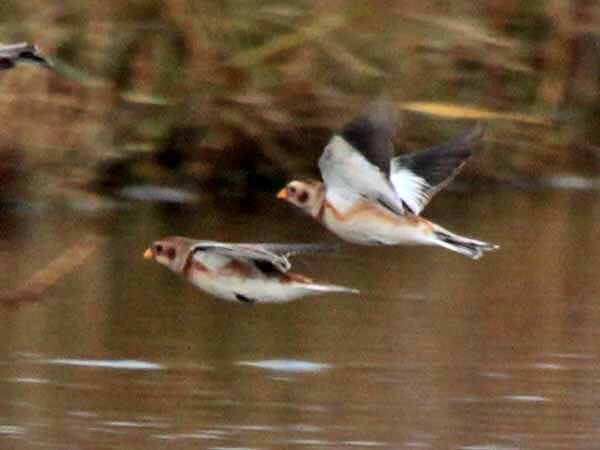
Snow Buntings, Salthouse, 3rd January
This Herring Gull gave the impression of being big and dark making me wonder if it might be argentatus. Really not sure though - any ideas welcome.


Herring Gull, Salthouse, 3rd January
On the way home I stopped off at Bayfield Lake. While I was there several skeins of Pink-footed Geese were flying over. One group came down and circled the lake as if they were going to land, although they eventually carried on off, but these were no Pinks. This party of 12 birds proved to be a mixture of Tundra Bean Geese (the majority, probably 9) and White-fronted Geese (at least 3). On the deck among the feral Greylags was another party of 6 White-fronted Geese.

White-fronted Geese, Bayfield Lake, 3rd January
I also had a quick look at the local patch where the White-fronted Goose flock remained - I couldn't tell how many birds were here on this occasion as they were mostly keeping out of view in long grass behind Greylags.
Two days later I couldn't find the White-front flock at all, though they were seen later. I counted 646 Greylag Geese while looking. Nothing else on the patch better than Bullfinches and Marsh Tit, both of which are regularly encountered there at the moment.
On 6th I headed to my old patch of Swanton Morley for the first time in ages. Saw a Little Owl on the edge of Swanton Morley village on the way. As I walked round the fishing lakes a Redpoll flew over, but none were in the alders where they used to frequent. A Peregrine flying over was good for the site, or at least it would have been a few years ago when I went there more often. Little Egret, Bullfinch, Treecreeper and 10 Siskins were more typical records for the site. A flock of 5 swans flew directly over my head and away to the north west. I couldn't see their bills at all but I got the distinct impression that they were Whooper Swans, the immatures looking grey and the necks long.
I then drove through Bylaugh and Sparham Hole stopping at the corner to look at a small bunting flock. As I stopped I picked up a distant flock of 5 swans flying north-west, the same direction as the previous flock of 5 suspected Whoopers. Frustratingly they were too far off to see any detail of the bill pattern (except to eliminate Mute Swan which was already eliminated by the grey plunage tones of the immatures). From the length of the neck I am pretty sure these were Whooper Swans too, but annoyingly I can't be positive about the ID of either flock. Either Bewick's or Whooper would be good for the Wensum Valley. As I received reports from other observers during the day it became clear that there was quite a passage of Whooper Swans around the county so I very much expect that that's what they were, but there were Bewick's reported on the move too so I still can't be 100% certain.
I only managed to get a good look at 4-5 birds from the bunting flock I stopped for (including Yellowhammers and Reed Buntings) - the others disappeared as I stopped, or maybe there weren't as many as I thought in the first place. In the field were over 400 Linnets and some thrushes.

Mistle Thrushes, near Sparham, 6th January
Next day I was up at Titchwell with the usual group. We headed to Patsy's Pool first where a first-winter drake Goldeneye was the highlight. This Robin was very tame...

Robin, Titchwell, 7th January
As we headed back a female Bullfinch provided brief views for the group. We headed to the beach next fearing that the mist would close in preventing views later on. On the way out there were 2 Spotted Redshanks and a Water Rail swimming towards us.


Water Rail, Titchwell, 7th January
On the sea the birds weren't as close in as they sometimes are and with the mist and breeze it wasn't ideal conditions for getting the group on to Long-tailed Ducks and Velvet Scoters. At least 15 Goldeneyes. 8 Red-breasted Mergansers and 3 Eiders too, but no sign of any of the Glaucous Gulls that had been there the day before.
We retreated to the relative warmth of the central hides where 16 Avocets were counted. Most of the group then returned to the cafe while two of us headed back to the beach where the ducks were showing slightly better now, including at least 25 Long-tailed Ducks and 15 Velvet Scoters. A brute of a juvenile Glaucous Gull was picked up washing itself in the sea just offshore towards Brancaster. As we headed back to join the others in the cafe I looked for Water Rails in the ditches as I always do, saying to Jos, "I haven't seen a Water Rail here for a while." Someone coming the other direction overheard me and said, "There's one down there." Sure enough there was a Water Rail right under my nose.
Exciting news emerged from Newmarket on the evening of 8th January. Someone had photographed a warbler coming down to drink from a puddle in a car park and asked for ID. The photos were quite good and appeared to show an Orphean Warbler. There was much discussion about the identity on social media, but all I saw was focused on whether it was a Western Orphean Warbler or an Eastern Orphean Warbler. Any Orphean Warbler is ultra-rare in the UK and it has long been one of my most sought-after birds. I've always loved Sylvia warblers, even the common ones. The scarce Barred Warbler was one of my earliest self-found birds of that calibre and in the early 90s I connected with Britain's first Spectacled and second Marmora's Warblers, Norfolk's first Rüppell's and Desert Warblers, and Sardinian and Subalpine Warblers. In these pre-split days when there was only one species of Orphean Warbler, one Subalpine Warbler and one Lesser Whitethroat that left just Orphean Warbler to complete an impressive list of birds in my favourite genus. With the various recent splits there are now new gaps to fill but Orphean has remained very high on my most-wanted list. And now there was one overwintering in a car park in Newmarket!
I arrived before dawn and quickly located the car park and even the puddle it was photographed drinking from. Thick vegetation behind it might be where it was lurking, but there was plenty of equally good habitat around. An apple tree nearby was worth keeping an eye on - the Pembrokeshire Orphean a few years ago liked apples. A crowd stayed looking in the car park while others of us spread out wandering around the estate peering in gardens and scouring shrubbery. Hours later the Orphean Warbler had failed to show and it was starting to look like we would dip. A Grey Wagtail and a Bullfinch were the best birds I'd seen!
After one more circuit of the estate I walked back towards the car park and looked up at the apple tree. Out of the corner of my eye I noticed Mick Saunt walking away from the apple tree but stop in his tracks before looking back at it, and at this point I locked on to a Sylvia warbler, a Lesser Whitethroat-like bird, feeding in the tree. Surely this was it... Being cautious I shouted, "Sylvia warbler" but surely this was going to be the Orphean - the odds of a Lesser Whitethroat being here in January as well were very remote. I got my scope on it excitedly and was elated to see it had a pale eye (Lesser Whitethroats have dark eyes and Orphean Warblers have pale eyes) and a big-looking bill (another feature of Orphean). It was the Orphean Warbler! I was so happy I punched the air - a bird I'd wanted to see for so long had just appeared in front of me. It soon moved back to the cover that it turned out Mick had seen it fly to the tree from and I joined the crowd. The bird hadn't seemed as big as I had expected - Orphean Warblers are big for Sylvia warblers - this one looked really quite a lot like a Lesser Whitethroat.
I remarked to someone how easy it would be to overlook one as a Lesser Whitethroat as it appeared again in ivy before returning to the apple tree again. By now it was raining but I checked the undertail to look for clues as to which form of Orphean it was. There is some variation but I think Western tends to have a creamy coloured vent whereas Eastern tends to be whiter with dark markings. It looked white, but clean. Another look at the face confirmed the eye colour and the bill. Actually the feathering round the bill was worn making the bill look longer than it really was - taking that into account it wasn't all that obviosuly bigger than a Lesser Whitethroat's bill, though at this point I did think it was a bit stouter too.
The bird we were looking at was quite obviously the same bird we had seen in the photos last night, and last night there was no question about the bird's identity as an Orphean Warbler. It was an Orphean Warbler last night, and this was the same bird. I think if there had been no photos last night, but just a claim of an Orphean Warbler, my process of being critical about the identification would have been different, more suspicious, more cautious. I guess that's why it took a little longer for me for the penny to drop that this Lesser Whitethroat-like Orphean Warbler might not actually be an Orphean Warbler. Perhaps the penny would have dropped quicker if I'd seen more Orphean Warblers abroad too. But as it was it took other experienced observers on site to say they thought it was just a Lesser Whitethroat. Slowly I started to realise that yes, that would explain why it looked so much like a Lesser Whitethroat. But the pale eye - one or two people were questioning whether it really had a pale eye - well yes, it definitely did! But apparently Lesser Whitethroats sometimes do have pale eyes, especially eastern ones I subsequently learned. I probably should have known that already but somehow that piece of knowledge had bypassed me up to now. Some of the photos still looked like they showed a big bill, not just long, although admittedly it didn't look so good in other photos. I wasn't completely convinced, but as the rain hardened I retreated to my car and checked Twitter where one of the photographers present had already posted some pics of the bird. They showed a bill that was clearly too fine for any Orphean Warbler - long due to the tatty feathers at the base of the bill, but fine. The nail was in the coffin now - there was no way of avoiding the crushingly disappointing conclusion that this bird was indeed a Lesser Whitethroat and not an Orphean Warbler.

Lesser Whitethroat, Newmarket, 9th January


%2B(1).JPG)
%2B(3).JPG)
%2B(5).JPG)
%2B(9).JPG)
%2B(12)%2BL.JPG)
%2B(14)%2BL.JPG)
%2B(17)%2BL.JPG)
%2B(18)%2BL.JPG)
%2B(2)%2BL.JPG)
%2B(5)%2BL.JPG)
%2B(4)%2BL.JPG)
%2B(7)%2BL.JPG)
%2B(3).JPG)
%2B(5)%2BL.JPG)
%2B(6)%2BL.JPG)
%2B(1)%2BL.JPG)
%2B(1)%2BL.JPG)
%2B(3)%2BL.JPG)
%2B(4)%2BL.JPG)
%2B(1)%2BL.JPG)
%2B(2)%2BL.JPG)